
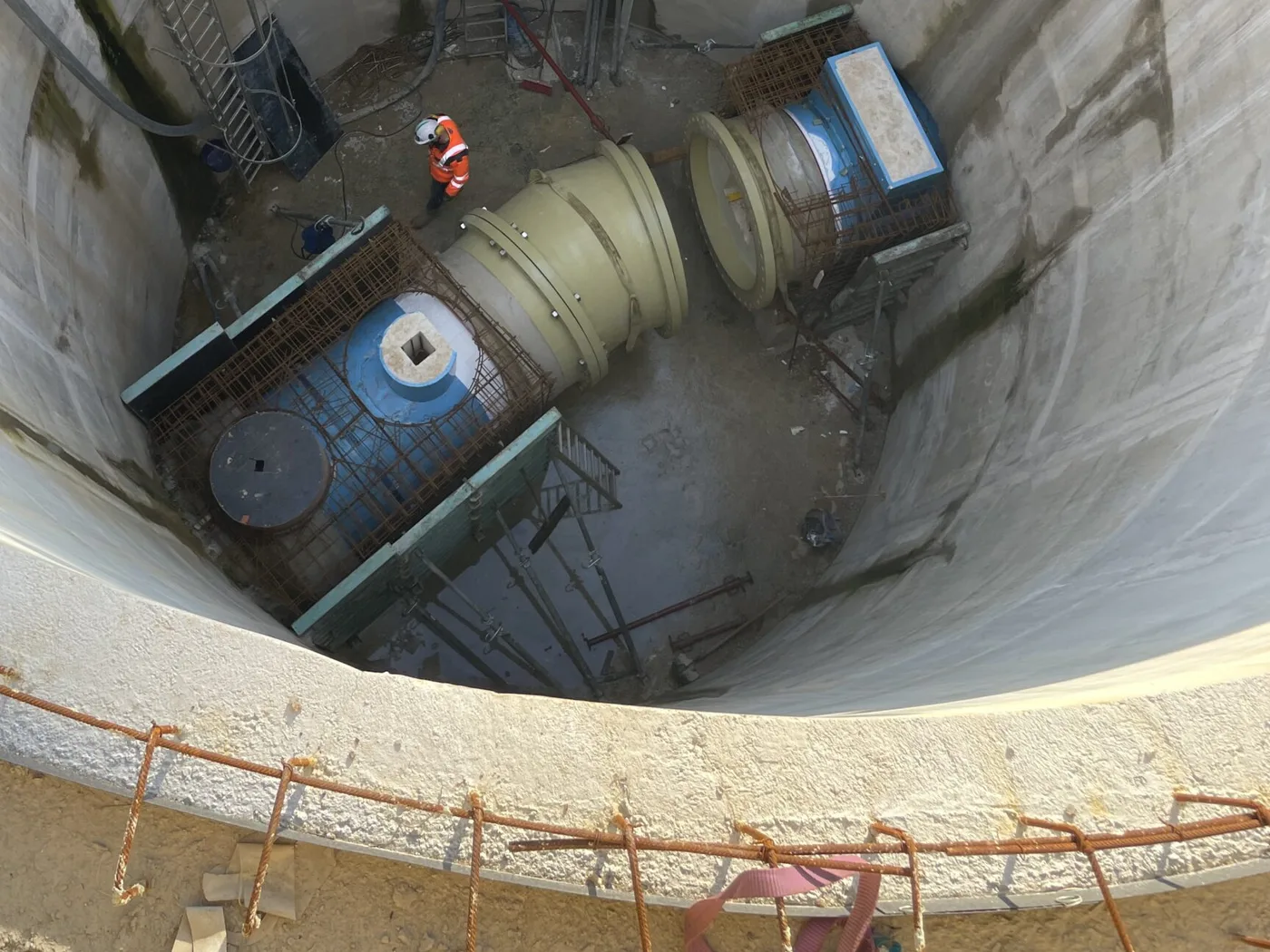
Accessories for GRP, HDPE and steel-cylinder reinforced concrete pipes
Each type of pipe has its own accessories: couplings, fittings, bends, tees, manholes and made-to-measure parts. Find below those for each family.
Accessories for GRP pipes
GRP pipes can be joined with coupling sleeves, a simple, quick and reliable solution to guarantee the watertightness and continuity of the network. This connection is valued for its ease of installation, its flexibility and its compatibility with gravity and pressure networks.
Joining systems with “Full-Face” couplings
| Accessory | Description |
|---|---|
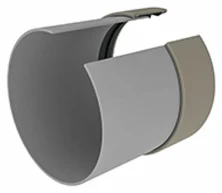 Standard coupling with elastomer gasket | Ideal for gravity networks. Quick to install, very good watertightness. |
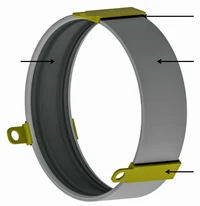 Repair coupling / sliding coupling | Allows a section to be repaired without cutting long lengths. Very useful for network maintenance. |
| Transition coupling | To connect GRP and concrete, GRP and HDPE, GRP and steel. Widely used in renovation or network extension. |
| Factory-crimped joint (centrifugally cast GRP) | Joint at the socket, crimped directly in the factory, which guarantees reliable and constant watertightness: the joint is positioned precisely, which removes the risk of errors during installation. |
GRP pipes and fittings are made to the standard dimensions of the range; an intermediate diameter is available made to measure.
GRP manholes
GRP manholes are designed to provide a complete, durable and fully watertight solution for gravity networks: wastewater, stormwater, sewerage, drainage and industrial applications. Made of high-performance composite materials, they advantageously replace traditional concrete manholes thanks to their light weight, strength, watertightness and design flexibility. First range of manholes certified EN 15383.
- Non-corrosive material, ideal in aggressive environments (H₂S, variable pH)
- No risk of infiltration or exfiltration, closed monolithic base possible
- No curing time, no formwork, no mandatory concrete pouring
- Multiple geometries, angles, diameters and heights
- Perfect integration with GRP pipes: connection by an EPDM coupling identical to the one used on the pipes
| Accessory | Description |
|---|---|
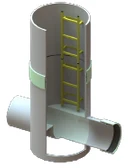 Standard manhole | Prefabricated base with integrated inlet and outlet pipes. Configurable diameters and invert levels. Height adjustable with a GRP coupling and riser. Inlet and outlet angles made to measure. Closed or open base depending on site requirements. |
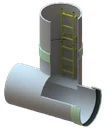 Tangential manhole | Ideal solution for large-diameter collectors (DN > 800), with the possibility of adapting to smaller diameters. Shaft generally designed off-centre. Variable configuration depending on the diameter ratio between the collector and the manhole. Available in direct tangential version (without benching) or tangential with benching. |
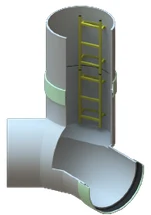 Manhole at change of direction | An alternative to the tangential manhole, positioned directly at the point where the pipeline changes direction. The shaft can rise on the outside or the inside of the bend, depending on the desired configuration. The number of segments follows the standard configuration of GRP bends; the length of the cut sections is adjusted to the shaft diameter. |
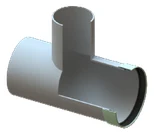 Centred manhole | Centred shaft, designed as a standard tee element. Ideal when maintenance and cleaning operations can be carried out from ground level, without entering the pipe. A simple, direct solution suited to networks where internal access is not necessarily required. |
GRP manhole options and accessories
| Accessory | Description |
|---|---|
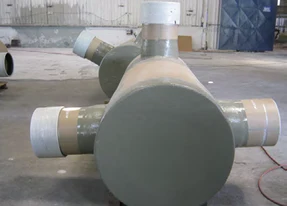 Closed manhole base | Closed manhole base with GRP lining. Closed monolithic base possible. |
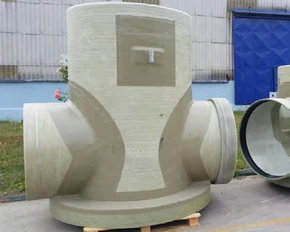 Anti-flotation base plate | Base extended beyond the manhole diameter, in GRP, to ballast the manhole with the weight of the soil. Ballasting possible for installation in a high water table. |
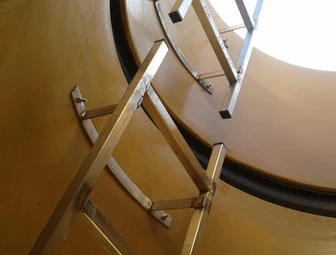 Ladder | Stainless steel 304, stainless steel 316 or GRP ladder. Watertight ladder bolts with GRP lining. |
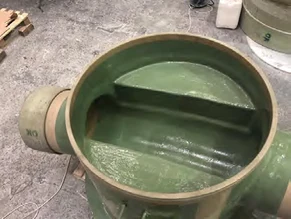 Benching | Preformed GRP benching on a standard manhole. |
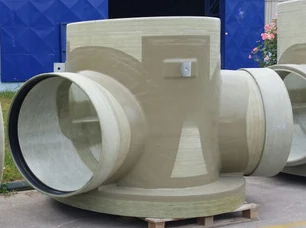 Lifting rings | For handling: use all lifting points to spread the loads. |
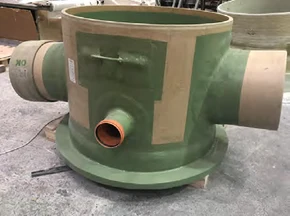 Connection to other pipe materials | For example, a PVC pipe laminated onto the GRP manhole. |
Manholes suitable for gravity systems (pressure class PN 1; they can operate under pressure). Default stiffness class: SN 10,000 or SN 20,000 N/m², other classes on request. Continuous service temperature from -40 °C to +35 °C. Manufactured by filament winding, centrifugal casting or helical winding. For industrial wastewater, the chemicals and their concentrations must be provided so that the suitable product can be chosen.
For more information, download the brochure.
Accessories for HDPE pipes
Electrofusion fittings
| Accessory | Description |
|---|---|
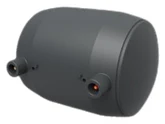 Electrofusion coupling | Used to join two pipes in line. This is the most common fitting. |
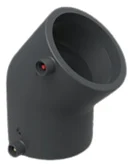 Electrofusion bend (45° / 90°) | Allows a change of direction while keeping a reliable weld. |
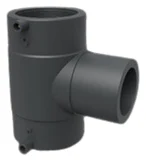 Electrofusion tee | Used to create a branch or connect a secondary branch. |
| Electrofusion reducer | Allows a change from one diameter to another while keeping a welded joint. |
| Electrofusion saddle (or tapping saddle) | Ideal for creating a branch on an existing pipe without cutting it completely. |
| Electrofusion end cap | Used to close the end of a network durably. |
Each fitting includes a heating coil: a low voltage (about 45 V) fuses the PE of the pipe and the fitting together, for lasting watertightness. HDPE pipes can also be joined by butt welding or mechanical fittings.
For more information, download the brochure.
Accessories for double-wall corrugated HDPE pipes
Accessories for double-wall corrugated pipes
| Accessory | Description |
|---|---|
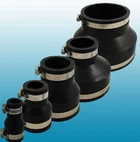 Joining couplings | External HDPE coupling, with or without gasket, suited to stiffness classes SN4, SN8 and SN16. Joins two pipes end to end. |
| EPDM sealing gaskets | Specific profile for the corrugated groove. Ensure gravity watertightness and withstand stormwater and wastewater. |
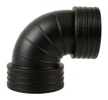 Double-wall bends | 15°, 30°, 45° and 90°. Same structure and stiffness as the pipes, for changes of direction in buried networks. |
| Tees and Y-pieces | 90° tees and 45° Y-pieces, for stormwater or gravity sewerage connections. |
| Reducers | To go from a larger diameter to a smaller one. Double-wall, compatible with standard couplings. |
| Branch fittings | Allow a lateral branch to be created on a collector, by push-fit with an EPDM gasket. Compatible with gravity networks and retention basins. |
| Manholes and inspection chambers | Compatible inspection manholes, corrugated or smooth connections depending on the model, flat or sloped base. |
| End caps / plugs | To close an end. Used in basins, standby networks and watertightness tests. |
| Special parts | Some parts (inlets, outlets, shut-off plates, manifolds) can be welded in the workshop to suit the retention basin configuration. |
On site, lengths of double-wall corrugated pipe are joined by an external coupling with an EPDM gasket, without welding. A complete range of accessories makes it possible to build any network configuration.
For more information, download the brochure.
Accessories for GRP shells
Parts accompanying the shells
| Accessory | Description |
|---|---|
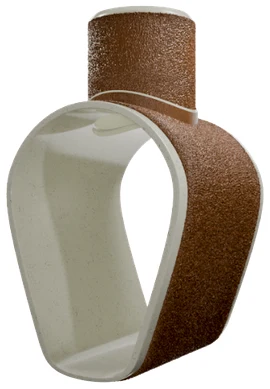 Access manholes | Manhole designed and made to measure to fit all sizes and shapes of manholes, with an exact match to the existing structure. The upper transition section can be eccentric or concentric, conical or any other shape. It can also be made in several panel sections to ease handling, transport and installation. |
For more information, download the brochure.
Accessories for steel-cylinder reinforced concrete
Connection parts
| Accessory | Description |
|---|---|
| Bends | Angles suited to the network layout. |
| Tees and Y-pieces | For branches. |
| Flanged parts | For connection to hydraulic equipment. |
| Special couplings | For complex junctions. |
Closing and inspection parts
| Accessory | Description |
|---|---|
| End shut-off plates | To close the end of the network. |
| Inspection manholes | Built in or added on. |
| Access chambers | For inspection and maintenance. |
Custom parts
| Accessory | Description |
|---|---|
| Specific inlets and outlets | Water intakes, outfalls, discharge lines. |
| Manifolds and distribution chambers | According to the project’s needs. |
| Fabricated metalwork elements | Suited to the project’s constraints. |
These accessories are made to the same strength and watertightness requirements as the main pipes, ensuring perfect hydraulic and mechanical continuity.
Types of pipe joint
| Accessory | Description |
|---|---|
| Butt-welded joint | Steel-cylinder ends (male/female) are joined by welding, followed by concrete filling inside and outside. Ensures structural continuity and perfect watertightness, ideal for pressure networks. |
| Elastic joint | Push-fit joint with a metal spigot and a rubber ring, made of two ends, one male and one female. Flexible system, suited to gravity or low-pressure networks, with good watertightness. |
For more information, download the brochure.
Your questions about accessories
Which accessories connect a GRP pipe to another material?
The transition coupling connects GRP to concrete, HDPE or steel. It is widely used in renovation or network extension.
How are HDPE pipes joined?
HDPE pipes are joined by electrofusion (electrofusion couplings, bends, tees, reducers, saddles and end caps), by butt welding or by mechanical fittings. Double-wall corrugated pipes are joined by an external coupling with an EPDM gasket, without welding.
Which types of joint exist for steel-cylinder reinforced concrete?
The butt-welded joint, rigid and ideal for pressure networks, and the elastic joint, flexible, for gravity or low-pressure networks.
Can accessories be made to measure?
Yes: for GRP shells and steel-cylinder reinforced concrete, special parts are designed to measure according to the project’s constraints. We help you define the right part.
Need personalised support?
Tell us about your project: we help you choose the right solution, size it and prepare the installation. Marc Sadok replies promptly.